


Who will pay for Frozen Food Innovation?
When looking for prospective clients I ask the question, “how many direct innovations are available?” I personally prefer indirect innovations but it’s much easier for new clients to understand and accept direct ones. This makes my value to the client more apparent so they are happy.
So I recently came across contact information for an executive of a company that makes frozen foods. I plugged a little information into the Predictive Innovation Method and in 2 minutes came up with one extremely valuable direct innovation for that industry and a simple way to make it. This innovation could save the company millions of dollars, possibly save lives and be a great product differentiator.
Even better this innovation has been publicly available for over 20 years. No R&D is needed. Plus there is an even better improvement to the idea that they could release later.
So now my question is, how do I make money from this? One way is to hint that I know something that will save the company money and could be used as a brand differentiator and possibly prevent serious legal damages. Then hope they will pay me to tell them.
That doesn’t sound very promising. But maybe I could offer the same information to all the competitors in the market, maybe that would increase my chances of success. There are about five big brands I could try. Maybe I can increase the urgency by telling each that I am making the offer to competitors.
Or I can employ my favorite type of innovation, the indirect alternative. I can approach attorneys for food born illness cases and tell them that I have proof these companies deliberately did not take reasonable measures to protect the health and safety of people eating their food. This information would likely drastically increase damages possibly being worth millions of dollars.
The information is worth exactly the same amount to the attorney’s as it is the food company but it costs the attorneys much less to act on the information. The food companies need to change their manufacturing process, plus the small cost to each item. The attorney’s only need to present the information in court or a settlement meeting. And the fact that the food companies made an economic decision to risk the health and safety of the public would be very damaging in a court case especially if the media reported on it. That type of information would make the attorney’s job much easier.
If you are paying attention you will see that I can find many other types of people who could benefit from this innovation or just knowledge of the innovation.
Short list of types of customers for the innovation:
- Suppliers of the actual innovation (at least five)
- Shippers of the food (at least one for each frozen food company)
- Stores that sell the food (at least 5 major companies)
- Companies handling non-food frozen items (hundreds)
You might also realize that I can make money from all of the possibilities. The possibilities aren’t OR each one is an AND. So I turned that one opportunity into over 20. That is a possible increase of return on investment of 2000%
This type of strategy is only possible if you can reliably generate focused innovations on demand. Notice that I did not do an Intellectual Property expansion on this innovation. The Predictive Innovation Method reveals there are at least 105 different ways to achieve the same result of that one innovation. So if either of those potential customer’s want to pursue the innovation I can quickly find the lowest cost lowest risk way to achieve the highest profit.
Let’s see who will Pay for It.
Elephant Painting, example of Free and innovation
This article will introduce a concept that my next book covers in great detail. It is the biggest problem facing society and the most wonderful opportunity. It’s called Free.
While I was in Thailand I spent two days at Maesa Elephant Camp learning to be a mahout (elephant driver). It was one of the most magical experiences of my life. Interacting with the elephants, the scenery and the way the staff treated us was amazing. One of the things I got to do was make a painting with an elephant.
[kml_flashembed movie="http://www.youtube.com/v/kgjoDUMvlZ8" width="425" height="350" wmode="transparent" /]
Mark Frazier with Kong Kham Painting at Maesa Elephant Camp
Many of these elephants used to work in the timber industry. The need for elephants for logging has dropped so these elephants and the mahouts were out of work. This is an example of how technology advances and makes things free. Elephants once were the cheapest way to harvest logs in terms of time and materials. But now new technology makes it even easier. People used to pay mahouts to ride elephants but they no longer get paid to do that. That is the negative side.
The positive side is timber is much cheaper now so people in general have extra resources to use on other things. And that leads us to the positive effects of Free.
When the real cost, in time and materials of a product or service drop to the point where people don’t put much thought to the cost it is treated like Free. Think of a buffet. People will try a dish they might not because it costs them nothing. And of course the only way that a buffet can work is if the scale of sales make the individual costs cheap enough to let everyone take as much as they want. This is relative Free. An example of absolute Free is a by product of another process. If you were going to throw it away it is free.
Now that no one would pay mahouts to ride elephants some innovation was needed. The solution, charge people to ride elephants. This exact same thing has happened with many industries. Now that people have extra leisure time because the products are so much cheaper they value experiences. They are willing to pay to do something in the old way just to have fun.
After spending two days riding elephants I can assure you that doing it all day every day for a job is not fun. You would have to pay me to do that, but I was more than happy to pay to learn how to ride elephants and enjoy being with them for two days. It was fabulous. A once in a life time experience.
Thailand Traffic Innovation
For the last 3 weeks I’ve been in Thailand. As I always do I look for innovations or different approaches to innovation. Thailand is a very decentralized nation. This seems to contradict the extreme nationalism but things here don’t get done on a centralized basis. The bulk of activity happens at the personal and family level.
Any place you go there is someone selling something. Go to the park and there is someone renting mats to sit on the grass. Walk down the sidewalk and there are hundreds of food carts and other miscellaneous things for sale. And on the roads there is extreme variety. Bicycles, push carts, motorcycles, tuk tuks, cars, trucks converted in to buses, mini-buses, full sized buses and trucks. You might even see an elephant.
It’s well known that Bangkok traffic is some of the worst in the world. It took me 4 hours to ride a bus 6 miles (12 km). They don’t even bother having schedules because it is impossible for a bus or a car to know how long it will take to get anywhere in Bangkok. This is a huge drag on productivity. But rather than complain, Thais find their own individual solution.
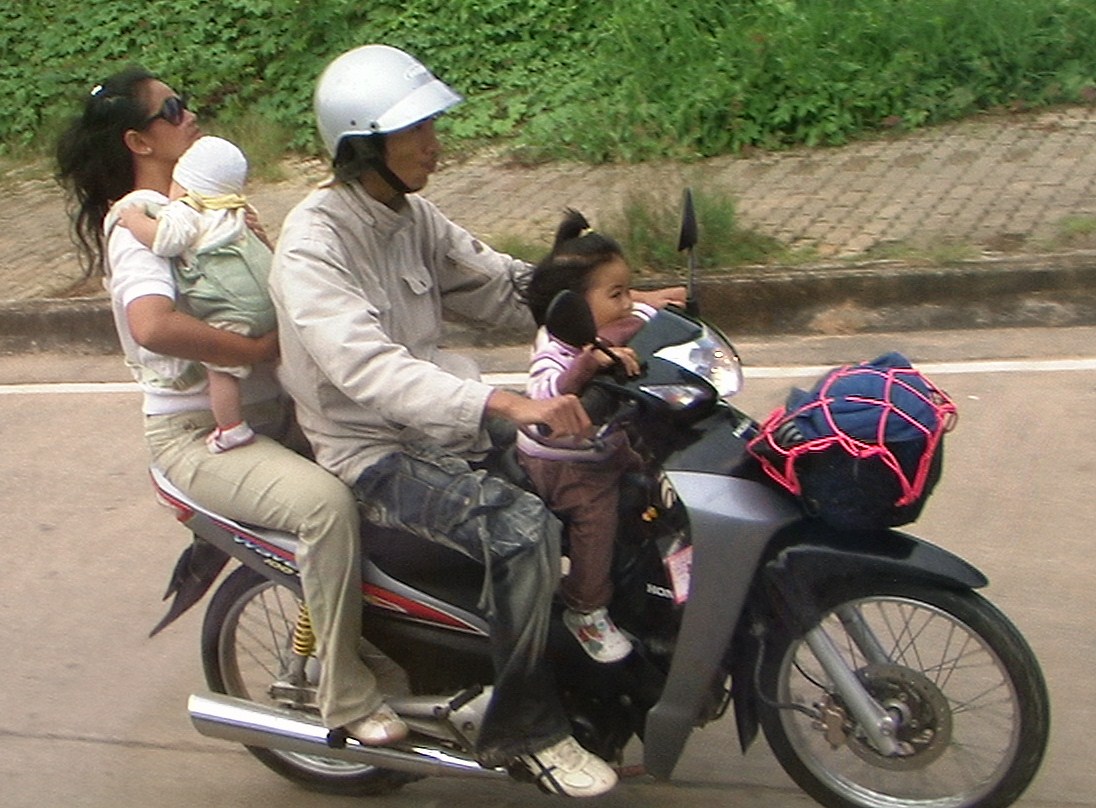
Family of Four on Motorbike in Thaialnd
My second home is Chicago and even though Chicago has nearly double the population density of Bangkok traffic runs very smoothly. Chicago’s traffic problems are mainly during rush hour on the expressways leading into or out of the city and surrounding sports stadiums before and after a game. Chicago has a subway and elevated, and buses that show up every ten minutes and you don’t have to negotiate the price of riding a taxi. Chicago is very organized and centrally controlled.
Am I suggesting Bangkok become more centralized? No. The centralized control is not what makes Chicago work. It’s the variety of options available to the individual. But didn’t I say that Bangkok has more options? Actually no. Even though there are many different types of vehicles they all have to travel the same path. The only way to travel through Bangkok is the city streets. If the roads are crowded in Chicago you can take the subway or light rail. You can drive on the city streets or the free way or the toll-expressway. And the buses have dedicated lanes.
The motorbikes in Bangkok have found an alternative road, the space between cars. When cars, trucks and buses are stopped the motorbikes drive between. Motorbikes don’t compete for the roads with the larger vehicles. The motorbikes are able to use an over looked resource, the small space between vehicles.
The motorbikes also follow another important aspect of successful innovation. An individual can easily purchase a motorbike. For the price of one months rent you can buy a motorbike. It does not require a large investment and switching to motorbikes can be done one person at a time. Incremental investment but huge gains for the person choosing a motorbike.
Bangkok has one elevated train called the Sky Way and a second Sky Way line under construction. The Sky Way is the nicest train I’ve every seen. It greatly helps those who want to travel along the line but it doesn’t do much good for others. The Sky Way is extremely expensive to build and doesn’t help anyone until the whole thing is completed. This is high cost and high risk.
One of the reasons the personal computer revolution and now the Internet has been so successful for innovation is nearly anyone can try something. The barriers to entry are very low and the rewards can be extremely high. Decentralized or at least distributed systems are much more likely to result in successful innovation. The “moon mission” approach usually fails. One of the big benefits of Predictive Innovation Method is it reveals all the alternatives. This allows you to build towards a large end goal but do it with small and progressively successful steps. That reduces risk, maximizes profits and eliminates the threat of competition.
 Predictive Innovation Training
 Predictive Innovation: Core Skills Book
 RoundSquareTriangle.com