


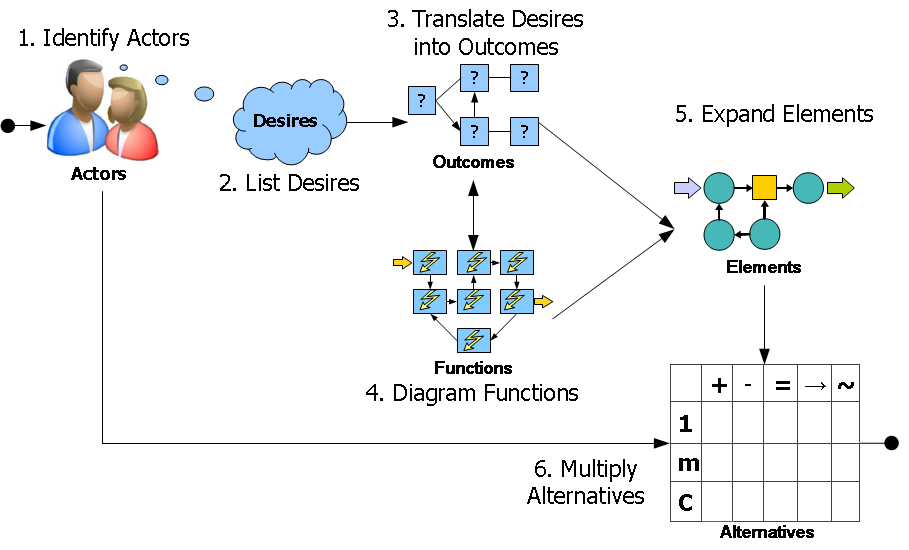
Predictive Innovation® reduces risk by providing decision makers the comprehensive list of options; so, they can confidently choose the best.
It allows you to see, in advance, what customers will want and how to most profitably make it from readily available resources.
The three key uses for Predictive Innovation are:
- Business Strategy
- New Product Development
- Problem Solving
Innovation requires thinking & doing. There are two broad categories of innovation systems:
- Thinking Systems
- Doing Systems
Doing systems organize your work. Doing systems are also called project management. Doing systems require the results of thinking systems to function.
There are some very good systems for doing. Examples of doing or project management systems are Staged Gate & Agile/Scrum. If you know what to make and how to make it a good project management system will help you efficiently do it.
Thinking systems help you find the answers to the crucial questions:
- Who will buy it & who will make it?
- Why do they want it?
- What to make and the criteria used to decide it’s good?
- How to make it?
- When to make and sell it?
- Where in the total supply chain to perform each task?
Project management does not help you answer these crucial questions. Innovation projects are notorious for having huge rates of failure. The root cause of the failure is skipping answering one or more of the crucial questions. Without first knowing the answers to these questions you’ll waste huge amounts of time and money on trial & error. Predictive Innovation solves that problem.
Predictive Innovation is a structured system for thinking. It’s based on the same science that allows digital computers to process information and is supported by over 25 years of research demonstrating its effectiveness. It breaks down any subject into the essential parts so you can quickly understand and see potential opportunities.
Predictive Innovation is predictive. It does this by giving you a structured way to efficiently focus in on the meaningful information and filter out the noise without missing anything important. That shines a light on the highly valuable unexpected ideas.
Doing Systems
Innovation doesn’t occur until the customer is using the product or service. Most companies consider the innovation process complete when they launch the product. That thinking stems from the belief that making something new is all that’s needed for innovation. The truth is that new doesn’t mean better or desirable. Even if a new product is absolutely amazing it doesn’t innovate unless customers know it satisfies their desire and are willing to pay to get it.
Agile / Scrum
Agile / Scrum is a project management system. It doesn’t have a thinking system. It assumes you have a customer who tells you “what to make” in the form of a backlog of requirements or “customer stories”. Designing, developing and bringing new products to market takes time. Waiting until customers are demanding an improvement causes customers to start looking for someone to provide it and they might not come to you. That forces you into a race. That leads to wasted effort, money, and lost profits.
Agile / Scrum also assumes that the people working on the project can just “figure out” how to solve the technical challenges and still stay on schedule. Without an effective “how to” thinking system, a project team can easily get stuck and waste time and money beating their heads against a wall.
Combining Predictive Innovation and Agile / Scrum is a powerful formula for success. Predictive Innovation proactively determines future requirements and Agile/Scrum helps to efficiently get solutions to market. Predictive Innovation also can show all the ways to make something so you know in advance if it’s possible and you can choose the most profitable approach.
Staged Gate
Staged Gate is a project management system. It doesn’t have a thinking system. It’s poor for new products because it’s based on trying a lot of different ideas and weeding out the failures. That’s deadly to a start-up that doesn’t have the deep pockets to keep funding trial and error. Staged Gate is notorious for high failure rates. However, Predictive Innovation principles have been demonstrated to increase the profitability of Staged Gate by 95 times with 96% success rates at launch.
Lean / Six-Sigma
Lean & Six-Sigma are not innovation systems. Lean and Six-Sigma are intended for repetitive processes such as manufacturing rather than innovation projects.
Many aspects of Predictive Innovation came from applying Lean & Six-Sigma concepts to project based activities. The result is by using Predictive Innovation you can make your innovation projects as repeatable and reliable as your Six-Sigma manufacturing processes.
Thinking Systems
TRIZ
TRIZ is a great thinking system for very specific types of “how to” problems. The name TRIZ is a Russian acronym meaning Theory of Inventive Problem Solving. TRIZ is great for its intended purpose but it’s too focused on problem solving and physical systems to be broadly useful for innovation.
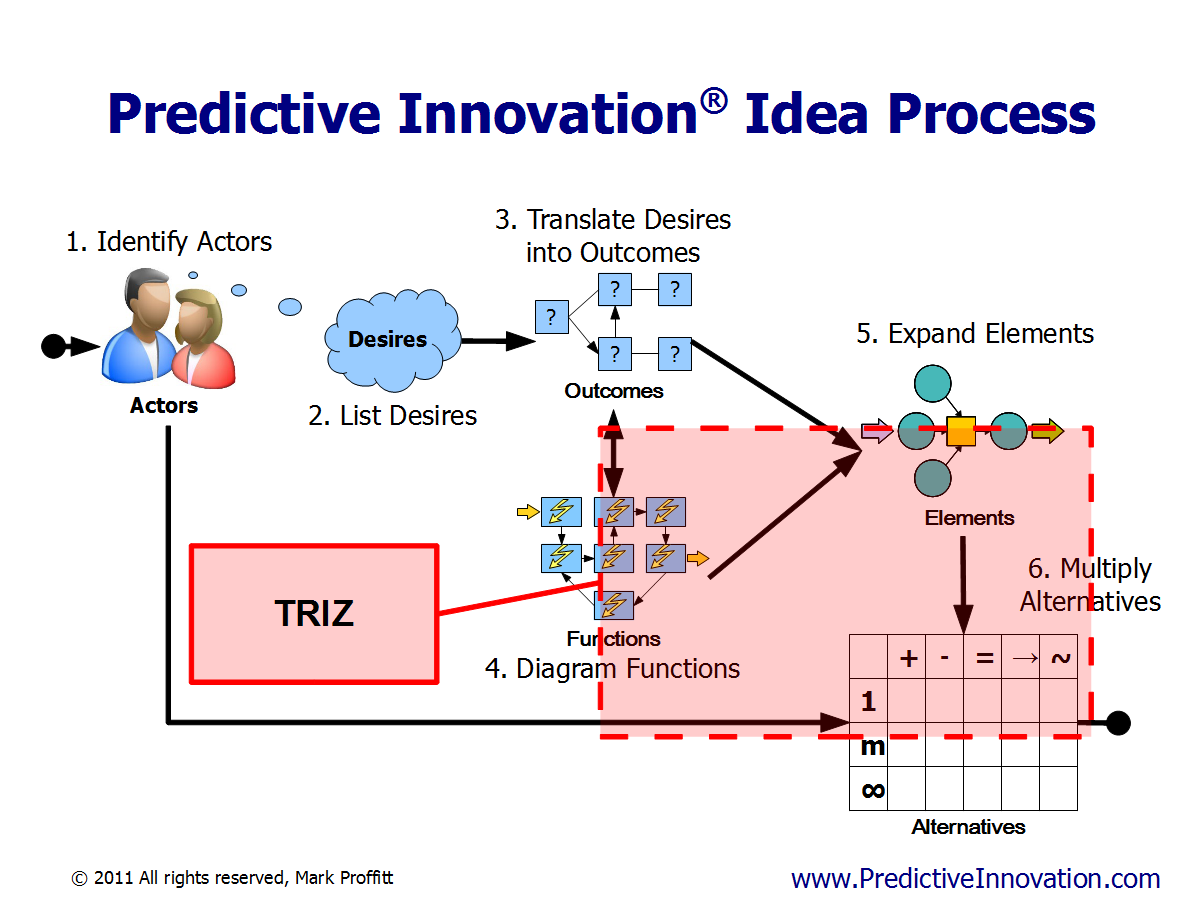 Since “how to” must come after knowing “what to make” TRIZ doesn’t help with the most critical part of innovation.
Furthermore, TRIZ is based on patterns found in patents; so, it heavily focuses on physical inventions. Since TRIZ doesn’t focus on the non-patentable innovations it can miss as much as 75% of possible innovations. That means TRIZ will tend to miss the highly profitable service and business model innovations.
Predictive Innovation shows you all the types of innovation. Seeing all the types of innovation gives you better choices plus creates synergies multiplying value.
Morphological Analysis
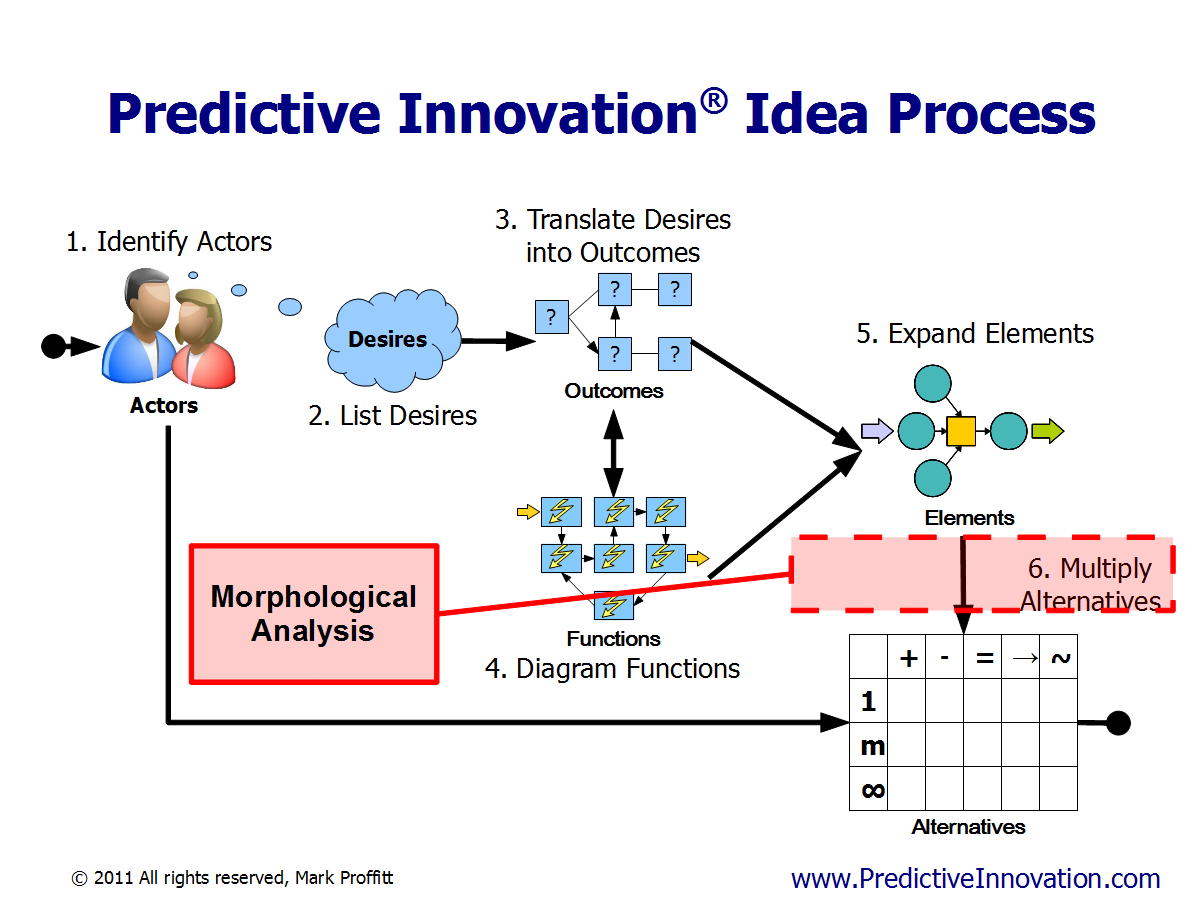 Morphological Analysis (MA) is a thinking system developed by the famous astrophysicist Dr. Fritz Zwicky. Morphological Analysis uses tables to identify combinations. Dr. Zwicky used MA to predict many discoveries including supernovae and neutron stars. The biggest problem with MA is it doesn’t have a clear way to specify what should be in the tables. Dr. Zwicky was a genius and MA tends to require similar expertise to set up the tables properly. Without clear rules for setting up the tables it misses valuable parts of the idea space. It can easily generate an overwhelming number of ideas yet completely miss entire categories of extremely important ideas.
Blue Ocean Strategy
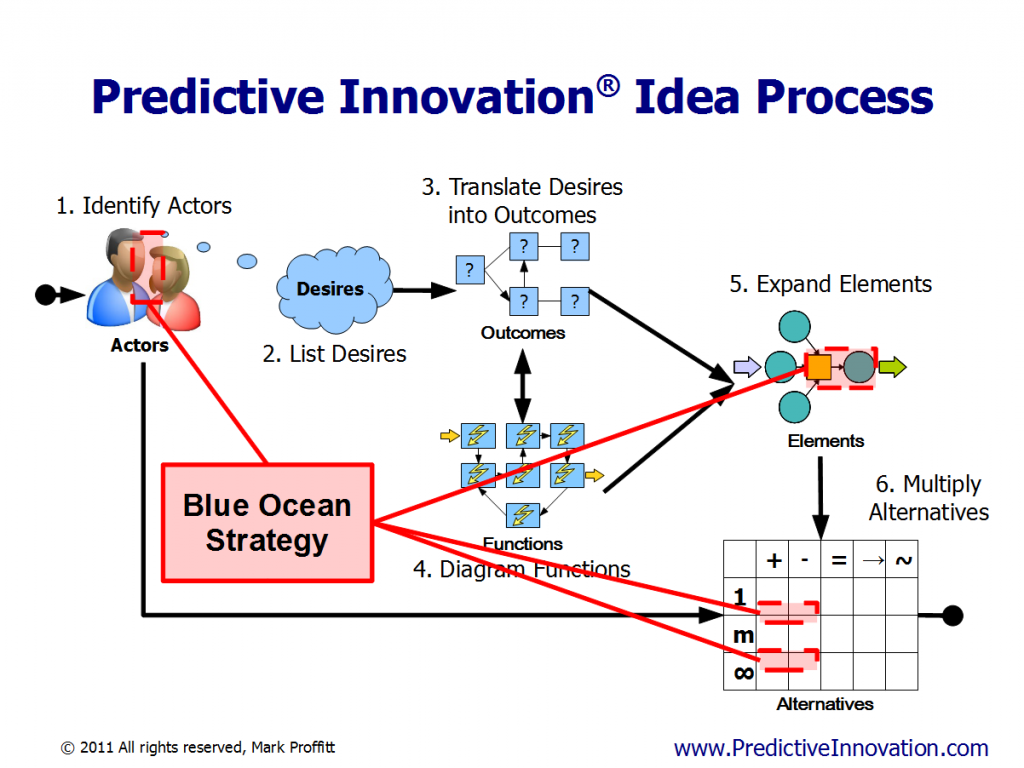 Blue Ocean Strategy is a combination of a goal, some tools, and a few guidelines for implementing a plan. It has a few aspects of a thinking system but isn’t complete. Plus, it makes several assumptions that are frequently incorrect.
The goal of Blue Ocean Strategy is to create a new market segment so you avoid competition; thus, hopefully being more profitable. This is a good strategy but not the only profitable strategy.
Blue Ocean offers a few tools that are parts of a thinking system. The tools offered only work for a few special cases. Unfortunately it doesn’t have a way for you to know if it will work or not. One of the tools is what they call the 4-Actions. These mirror a portion of Predictive Innovation’s 7 Elements and 15 Alternatives. Predictive Innovation shows there are a minimum of 15 Alternatives for each of the 7 Elements of each Outcome. Actions are only one of the 7 Elements. Blue Ocean doesn’t cover the other Elements. That means Blue Ocean’s tool is only 3.8% of a complete system. It’s likely to send you crashing into the rocks to sink to the bottom.
The most valuable parts of Blue Ocean are the guidelines for implementing a plan.
If you want to reliably create Blue Ocean Strategies you need the lighthouse of Predictive Innovation to guide you safely around the hidden icebergs to the treasure.
Creativity
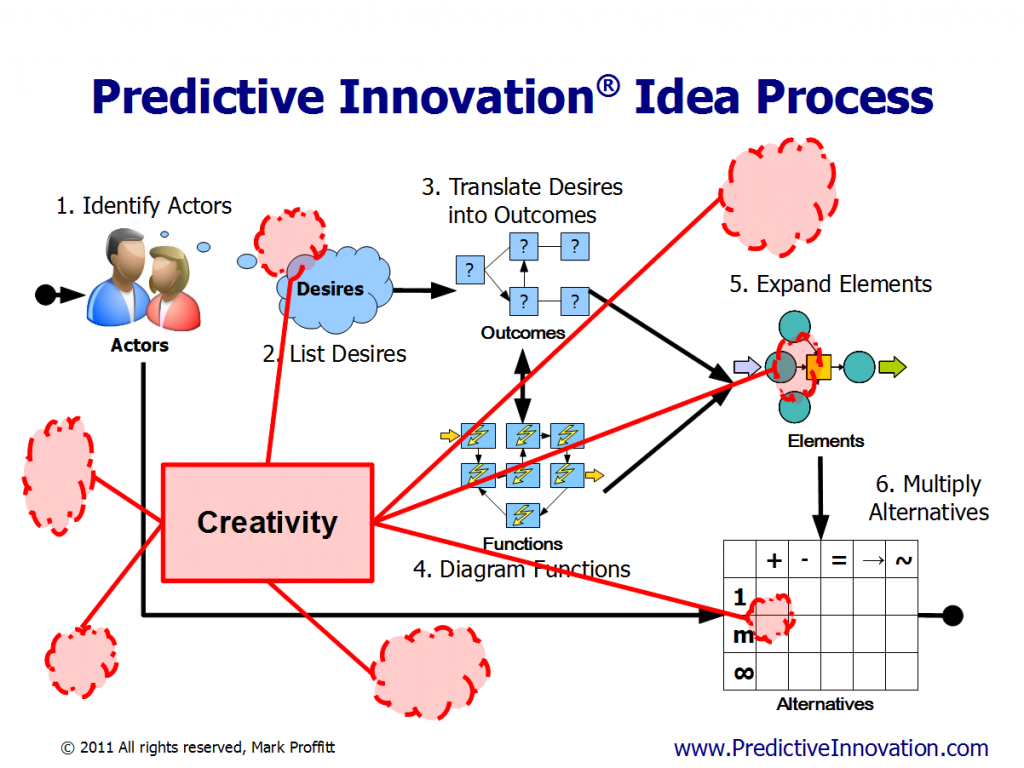 Creativity is the most common system for finding ideas. It’s also the least successful. There are countless creativity based approaches to idea generation. Some of the creativity approaches are: Brainstorming, DeBono’s Six Hats, Killer Questions, Lateral Thinking, the list is practically endless. All of those are supposed to be thinking systems but in effect are the opposite of thinking.
The supposed “Fuzzy Front End” of innovation gets the name because of people using Creativity to generate ideas. The lack of objective criteria causes the confused fuzzy blurred vision.
Creativity is a random approach. Because it’s random it focuses on increasing the quantity of ideas ignoring quality. It specifically avoids criteria for evaluating ideas so it wastes a lot of time on wacky irrelevant ideas that don’t lead to successful products. Without real customer centered criteria for evaluating ideas, creativity is prone to personalities driving decisions. With a less than 1% success rate, Creativity is worse than doing nothing at all.
Design Thinking
 Design Thinking is an incomplete system. It’s just a set of goals without a way to actually do it. The main goal is an attempt to consider how a product fits with other parts of the environment. Most people who claim to use Design Thinking are just using creativity with an iterative version of Staged Gate project management. The lack of a real thinking system makes Design Thinking very person specific and dependent on inherent talent. That makes it unrepeatable and difficult to scale.
Jobs-to-be Done / Outcomes Driven Innovation (ODI)
 JTBD/ODI has been shown to be up to 9 times better than creativity based systems. It’s great for “what to make” ideas but not “how to” make it solutions. Another weakness of JTBD/ODI is it relies on existing demand so the predictive value is decreased causing projects to start late relative to the market opportunity. It only covers about 13% of the “what to make” ideas space. Predictive Innovation covers the entire idea space. If you know JTBD or ODI you can easily learn Predictive Innovation and multiply your profits by another 8-9 times.
Open Innovation
The definition of Open Innovation is unclear. Typically it means asking potential customers for ideas. The concept of involving customers in the innovation process is great when used for gathering user requirements or “outcomes”. Just asking customers for ideas tends to be amplified random brainstorming which can be worse than nothing at all. It most often collects a tremendous amount of raw ideas causing even more wasted time on filtering and sorting.
Open Innovation can also lead to intellectual property problems that devalue otherwise good ideas.
Big Data
Big Data uses computers to brute force search through gigantic amounts of data hoping to find meaningful patterns in the noise. It can be great for finding connections or testing assumptions that would be impossible for a human to do because of the shear size of the problem.
By definition Big Data is looking at what was popular in the past. Big Data misses “why” it was popular. Without understanding why something was popular you can’t predict the future high value ideas.
Big Data is poor at predicting because it doesn’t understand the root causes. Computers are fast but can’t actually think. Ironically, it misses huge areas of information. Since Big Data is analyzing past records it only sees what you already chose to measure and record. The expression, hindsight is 20/20, accurately describes Big Data. That makes Big Data highly prone to unexpected “Black Swan” catastrophes. It’s like racing down the road while looking in the rear view mirror for guidance.
 Predictive Innovation Training
 Predictive Innovation: Core Skills Book
 RoundSquareTriangle.com